

Don’t let the size of our small country fool you! Throughout history, the Netherlands had (and still has) a big influence on the global economy and trade - especially around the 1600s, where they ruled global commerce with the companies VOC (Dutch East India Company) and WIC (Dutch West India Company). Did you know that the VOC was the first company in the world to issue stocks? They were so powerful they even had their own army and navy!
This traveling and trading around the world also left its mark through language. In this article, I take a quick dip into some of the influences of the Dutch language in other languages worldwide. The Japanese bĩru, for example, comes from Dutch!
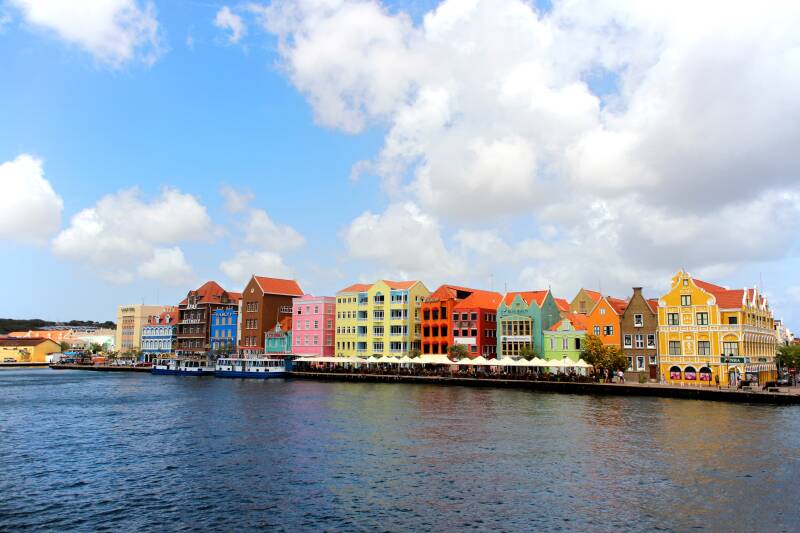
To give you some numbers: worldwide, there are around 24 million native Dutch speakers, with about 17 million in the Netherlands. Belgium has around 6.5 million, and Suriname 400,000. Dutch is also an official language in these countries, as well as in the Caribbean islands: Aruba, Curaçao (see photo) and Sint-Maarten. Dutch is one of the 40 most spoken languages worldwide, out of the 7,000 languages spoken globally!
Throughout history, the Dutch created trading posts that grew into colonies, and many Dutch people immigrated overseas. Linguistic studies have shown that 18,242 Dutch words made their way into 138 different languages, leading to 48,446 new borrowed words.
I thought it would be fun to give some examples, which I will order alphabetically by country. Sometimes the influence was not direct but indirect, through another country. For example, Finnish adopted the Dutch loanwords mainly through Swedish.
Some examples of loanwords derived from Dutch:
American English: waffle, cookie, beer, boss (wafel, koekje, bier, baas)
Brazilian: brote (biscuitje of cracker- van brood)
British English: yacht (jacht)
Chinese-Malay: kheskhèyen (gescheiden)
Danish: endivie (andijvie)
French: héberge, haïr (herberg, haten)
German: steuerbord, morast, seehund (stuurboord, moeras, zeehond)
Ghanaian: konõ (koning)
Indonesian: és, arbéi, nomor, mébel, hordéng, émosionil (ijs, aardbei, nummer, gordijn, emotioneel)
Japanese: bĩru, arukoru, dansu, mesu, ananasu (bier, alcohol, dans, mes, ananas)
Norwegian: kakerlak (kakkerlak)
Polish: hundekoja (hondenkooi)
Portuguese: bacalhau (kabeljauw - van bakeljauw)
Russian: škalik, šlagbon, magazin, ris, bírža (schaal, slagboom, winkel - van magazijn, beurs)
Spanish (South America): dique, duna, (dijk, duin)
Swedish: gevär (gevaar)
Tamil: pōñci (boontje)
Ukrainian: kófe (koffie)
South African (Afrikaans) has evolved from Dutch and is also called a daughter or sister language. ‘Hoe gaan dit?’, ‘Asseblief’
and ‘Baie Dankie’ are just a few examples that show the strong similarities.
I hope you enjoyed reading this article, and discovering the Dutch words in your native language!
Resources:
- Atlas van de Nederlandse taal (2022). Publisher Lannoo. A comprehensive atlas of the Dutch language.
- Nederlandse Taalunie at taalunie.org. Official website of the Dutch Language Union.